
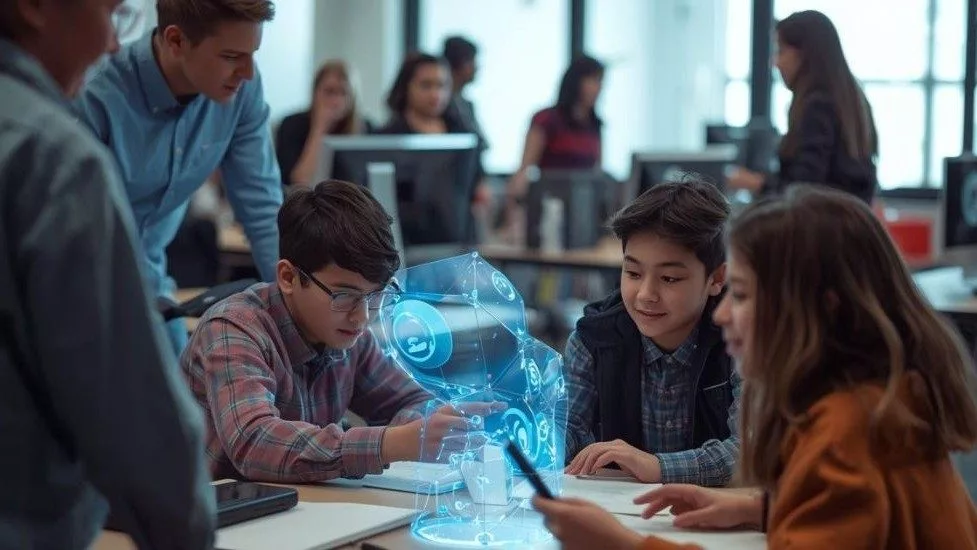
Fostering Transdisciplinary Learning: Rewiring education for the future with AI
The 21st century presents a fascinating paradox: we have unprecedented access to information, yet the global challenges we face—from climate change to economic instability—are more complex and interconnected than ever before. In this era of rapid change, the old model of education, where subjects are sealed off in rigid compartments, simply can’t keep up. To truly prepare students for a world that demands adaptability and holistic problem-solving, we must embrace a radical, yet essential, evolution: Transdisciplinary Learning, supercharged by Artificial Intelligence.
Transdisciplinarity is far more than just teaching two subjects at once. It’s a fundamental shift in perspective that means tearing down the traditional walls between disciplines and framing education around real-world problems. This ensures students don’t just learn what to know, but crucially, how to connect that knowledge to real-world action and collective well-being. This integrated approach isn’t just a niche idea—it’s currently one of the most valuable and sought-out educational processes worldwide!
The necessary evolution: Making learning a Lifelong Journey
The first crucial step is acknowledging a simple truth: education is a lifelong process and must extend far beyond the traditional classroom. Learning isn’t a task completed when you get a diploma; it’s a continuous, dynamic loop that fuels personal, professional, and societal growth.
This acknowledgment means schools can’t afford to stand still. We must recognize the need for continuous development and evolution of our education systems. Education is a living thing, and its curriculum, teaching methods, and assessment must evolve as fast as technology and society change.
To meet 21st-century demands, schools must courageously rethink and redesign learning, teaching, working, and collaboration. We need to move past the old “factory model,” where knowledge was processed on an assembly line, toward an agile ecosystem where innovation and fluidity are the norms. The classroom becomes just one hub in a vast network that includes digital platforms, community engagement, and project-based experimentation. This systemic redesign is essential for maximizing student curiosity and permanently dismantling isolated knowledge silos.
Breaking down silos: The educator’s role as integrator
The heavy lifting for this transformation rests on our educators. For too long, teachers have been expected to act as sole proprietors of their subjects, rarely communicating across departmental walls. This isolation prevents students from seeing the natural connections that exist everywhere in the real world.
The future demands that we equip educators to move away from isolated, single-discipline teaching and adopt transdisciplinary, agile curricula that foster integrated learning experiences. This means training teachers not just in what to teach, but how to co-design and co-deliver content that seamlessly weaves together concepts from multiple fields.
It’s critical that we promote interdepartmental collaboration among teachers to create aligned strategies that help students unlock their full potential. Imagine a project where the history, economics, and art teachers all work together to study the Renaissance. Instead of three separate units, students analyze the historical context, the trade routes that funded the movement, and the mathematical principles embedded in the era’s sculpture. This collaboration transforms fragmented facts into meaningful, coherent understanding. When teachers are aligned, the student’s learning pathway becomes exponentially clearer and more powerful.
The holistic compass: The Four Pillars of Learning
The philosophy behind this transdisciplinary shift is rooted in the UNESCO framework. We must emphasize the importance of the four pillars of education—a structure that guarantees comprehensive and holistic development:
- (a) Learning to know: Mastering knowledge and understanding the world.
- (b) Learning to do: Gaining practical skills and applying knowledge effectively.
- (c) Learning to live together: Developing social skills, understanding, and respect for others.
- (d) Learning to be: Cultivating personal potential, autonomy, judgment, and responsibility.
Transdisciplinary learning acts as the glue that connects these pillars. A project on renewable energy, for instance, requires students to know (pillar a) the science, do (pillar b) the engineering work, live together (pillar c) by debating policy implications, and be (pillar d) by taking ethical ownership of the environmental outcomes. When all four pillars are engaged, the learning experience is truly transformative.
Strategy in action: The AI-Enhanced STREAMS classroom
To give this vision structure, schools must implement transdisciplinary (STREAMS) approaches as a school-wide educational strategy for deeper understanding. STREAMS goes beyond the conventional STEM framework to include critical components: Science, Technology, Research/Reading/Writing, Engineering, Arts, Math, and Social Studies/Skills.
This is where technology enters as a game-changer. The AI-enhanced classroom provides fertile ground to revolutionize educational environments by offering new ways to engage students across multiple disciplines (STREAMS).
We must leverage cutting-edge AI technologies to enhance lifelong, student-centered learning experiences. The integration of Artificial Intelligence (AI) in education is revolutionizing learning environments. AI is the catalyst that moves transdisciplinarity from theory to reality. Specifically for K-12 education, AI technologies enhance this process by providing personalized, data-driven learning experiences and promoting collaboration across disciplines in a systemic and uninterrupted school-wide approach.
How AI fuels Transdisciplinarity:
- Precision Personalization: AI systems can instantly analyze a student’s mastery across different subjects (e.g., their math proficiency within a physics project). This allows the AI to provide highly customized resources, addressing a skill gap immediately and in context, ensuring the student’s learning flow isn’t interrupted.
- Uninterrupted Flow: By automating mundane tasks like grading and resource curation, AI ensures the learning process remains uninterrupted. Teachers are freed up to focus on facilitating critical discussions and complex problem-solving, which is where real learning happens.
- Systemic Cross-Referencing: AI tools can help teachers design projects by suggesting natural thematic and conceptual links between disciplines—for example, proposing a connection between the geometric principles in Art (A) and the engineering mechanics of a structure (E). This fosters the systemic approach needed for true transdisciplinarity.
The Outcome: Thinking for an uncertain world
The ultimate purpose of this deep, integrated, AI-enhanced learning is simple: to cultivate critical and creative thinking skills in learners to effectively address complex and uncertain challenges through collaboration.
The complex problems students will face in the next decade—from climate change to ethical dilemmas in tech—won’t have easy answers. They require individuals who can critically assess conflicting data (critical thinking), conceive novel solutions (creative thinking), and most importantly, work in diverse teams (collaboration). Transdisciplinary curricula, especially through project-based STREAMS experiences, immerse students in ambiguity, building the mental agility required to thrive when the path forward is uncertain.
Defining quality and localizing the vision
The effectiveness of this system depends entirely on the quality of its components. We must clearly define the essential characteristics of high-quality learning content and experiences: they must be relevant, ethically sound, demand active engagement, and—most importantly—foster skill transferability so students can apply what they learned in one context to a completely different one.
Finally, this global vision must be successfully brought home. We must actively work to align Cypriot curricular standards with transdisciplinary, integrated instruction and assessment practices. This means reforming national guidelines to explicitly support project-based learning, cross-curricular planning time, and assessment methods that genuinely value synthesis and application over simple recall.
By integrating the STREAMS framework, the Four Pillars, and the game-changing power of AI into policy and practice, we can ensure our education system is preparing students not just to participate in the global economy, but to lead it with creativity, critical insight, and collaborative strength. The shift to fostering transdisciplinary learning is a big undertaking, but the rewards—self-actualized individuals, resilient communities, and an education system truly fit for the future—are immeasurable.
If you want to learn more about how to revolutionize your classroom and align with global educational best practices, join us in our upcoming seminar.
Fostering Transdisciplinary Learning Processes in the AI Enhanced K-12 Classroom.
Register now and secure your spot: https://digipro.com.cy/seminars/fostering-transdisciplinary-learning-processes-in-the-ai-enhanced-k-12-classroom-25b/